
The Ombudsman received 276 complaints about Lewisham Council in 2025/26 and upheld 45 of the 52 it investigated. Its July letter warned of a systemic issue.
Complaints about Lewisham Council reaching the Local Government and Social Care Ombudsman rose by 52 per cent last year, to 276. Of the 52 it fully investigated, it upheld 45.
The figures are in the council’s annual complaints report, which went to Mayor and Cabinet on Wednesday 4 November (Lewisham Council, Annual Complaints Report 2025/26). The report also shows the council missing its own 90 per cent target for answering complaints on time.
In July the Ombudsman wrote to the council a second time in the same year, which it does only when it has concerns or wants to praise exceptional work. Its letter said repeated failures to carry out its recommendations “suggests a systemic issue in how the Council oversees our recommendations and prioritises complaints” (LGSCO annual review letter, 8 July 2026).
What the Ombudsman found
The Ombudsman’s own figures for the year to 31 March 2026 show (LGSCO, Lewisham statistics):
| Measure | Lewisham | Similar councils |
|---|---|---|
| Complaints investigated and upheld | 45 of 52 (87%) | 88% |
| Upheld decisions per 100,000 residents | 14.9 | 10.2 |
| Council had already put things right | 4 of 45 (9%) | 14% |
| Recommendations carried out | 37 of 38 (97%) | 100% |
| Recommendations carried out on time | 23 of 38 (61%) | 65% |
The upheld rate is close to the London average. The number of upheld cases per head is not: Lewisham’s is almost half as high again as the average for London boroughs.
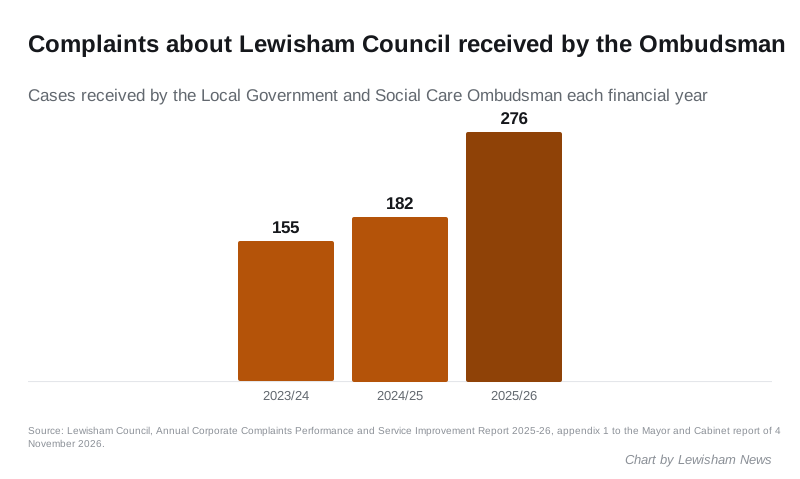
The council’s report puts the rise at 52 per cent on 2024/25 and 78 per cent on 2023/24 (appendix 1). Not every case is investigated. Of the 276, 88 were premature or for another ombudsman, and 75 were assessed and closed without a full investigation.
What the July letter said
The Ombudsman’s second letter raised three problems:
- Poor information. In seven cases the council’s answers to its enquiries included “large volumes of unstructured documentation, missing key documents, and evidence of poor local complaint handling”.
- Slow remedies. The council failed to show it had done what was agreed, on time, in more than a third of cases. Some of those delays held up apologies and payments to the people who had complained.
- A repeat refusal. In one case the council did not comply at all, so the Ombudsman registered a new complaint. It noted that non-compliance had also been recorded in 2024, 2022 and 2021.
“These issues have been raised in previous letters,” the letter said, “and it is concerning that any actions taken to date have not led to sustained improvement.”
Special needs cases lead the upheld list
Complaints about support for children with special educational needs made up more than a third of the cases the Ombudsman upheld, more than any other single issue, the council’s report says.
The remedies show what those failures cost families. In one case the council was told to pay £1,750 for the “loss of the chance of a school placement”, plus £450 and £300 for uncertainty and stress. In another it was told to pay £2,000 and produce an action plan for how it would properly consider alternative education.
The council’s own complaints
The council received 5,873 stage one complaints in 2025/26, down from 6,510 the year before. Its figures for answering on time were:
- stage one: 87.5%, up from 85%
- stage two: 56%, down from 71%
- councillors’ enquiries: 72%, up from 61%
- MPs’ enquiries: 74%, up from 71%
MPs’ enquiries rose to 2,558 from 1,947, and councillors’ enquiries to 3,177 from 2,503.
The most common complaints were about missed bin collections (13% of stage one complaints), council tax accounts (11%), street cleaning (7.6%) and parking tickets (4.8%). The council points out that its 1,130 waste complaints came against 402,000 collections a week.
The council’s response
The report is frank about its own system. Complaints are handled separately by each department, which it says makes consistent handling “challenging”. It says triage, responses, record-keeping and learning “have not met the standards we would expect”.
It also says many recorded complaints are really requests for a service, which “inflates” the totals. “Request for service” was the reason logged for 3,284 complaints. That label is being dropped, and complaints that are really about receiving a parking ticket will be refused and recorded as such in future.
The report says the share of complaints passing its own quality checks rose to 69 per cent, from 31 per cent in 2024/25, after training. Mayor and Cabinet were asked to note the report, endorse its improvement recommendations and ask officers to publish a response.
What it means for you
- How to complain: the council should acknowledge a complaint within five working days. It should answer at stage one within 10 working days and at stage two within 20.
- If it runs late or you are unhappy: after stage two you can go to the Local Government and Social Care Ombudsman. Complaints about the council as your landlord go to the Housing Ombudsman instead.
- Council tax queries: the report says there is no public-facing email address for council tax, so many enquiries arrive as complaints. Our Lewisham council tax bands page sets out what each band pays.
- If the Ombudsman has found in your favour and the council has not done what it agreed, tell the Ombudsman. The July letter shows it tracks late compliance.
Sources
- Lewisham Council, Annual Complaints Report 2025/26, report to Mayor and Cabinet, 4 November 2026
- Lewisham Council, Annual Corporate Complaints Performance and Service Improvement Report 2025-26, appendix 1 to the same report
- Local Government and Social Care Ombudsman, annual review letter to Lewisham, 8 July 2026
- Local Government and Social Care Ombudsman, London Borough of Lewisham statistics, read 6 November 2026
- Mayor and Cabinet, 4 November 2026: agenda and papers
Have your say