
CQC has rated Lewisham Council's adult social care requires improvement at 59%, four points short of good. 1,122 people were waiting a median 148 days for a review.
Lewisham Council’s adult social care service has been rated requires improvement by the Care Quality Commission, with an overall score of 59%, in the first inspection of its kind for the borough. The assessment report, published on 7 August 2026, found delays to assessments and annual reviews, uneven support for unpaid carers and gaps in mental health pathways, alongside a safeguarding service the regulator called a notable strength.
Since 2023 the CQC has assessed how every council in England meets its duties under the Care Act 2014. Each authority is scored on nine quality statements, from 1 (significant shortfalls) to 4 (exceptional), and the total is turned into a percentage. Under the CQC’s published thresholds, 39 to 62% is requires improvement and 63% or more is good. Lewisham’s 59% therefore sits four points below the good band, a point the council made in its own response on the same day.
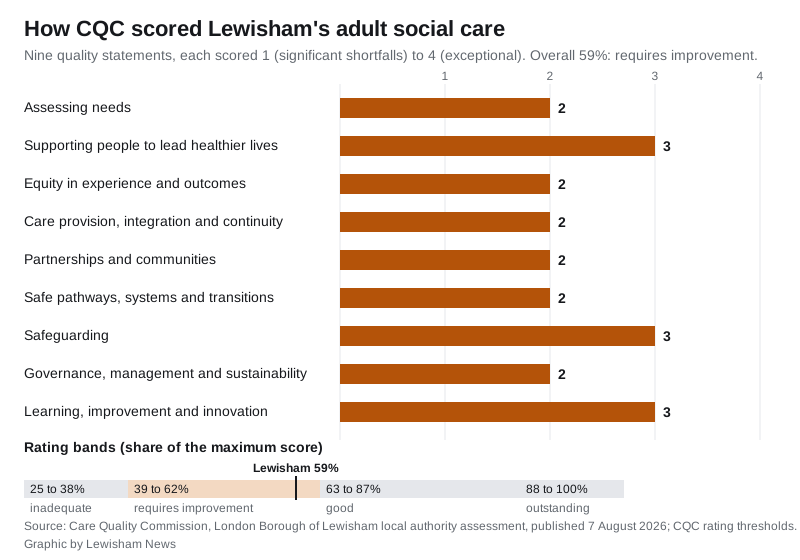
The nine scores
The CQC press release lists them: assessing needs 2; supporting people to lead healthier lives 3; equity in experience and outcomes 2; care provision, integration and continuity 2; partnerships and communities 2; safe pathways, systems and transitions 2; safeguarding 3; governance, management and sustainability 2; learning, improvement and innovation 3.
Mary Cridge, the CQC’s director of adult social care, said the inspection team “found a mixed picture of people’s experience accessing adult social care”. She said Lewisham “has built an inclusive and positive culture of continuous learning and improvement”, but that “delays to assessments and reviews meant some people were waiting too long to receive the support they needed”, and that “people using mental health services didn’t always experience joined-up support”.
The waiting lists
The most concrete findings are in the assessing needs section, which draws on data the council supplied in October 2025. At that point:
- 1,122 people were waiting for an annual review of their care. The median wait was 148 days and the longest 428 days, against a council target of 28 days from the review’s due date.
- For Care Act assessments of adults with a learning disability, autistic people and young people moving from children’s to adults’ services, 32 people were waiting, with a median wait of 76 days and a maximum of 203 days. The target is 42 days.
- In the neighbourhood teams, 44 people were waiting; the median wait of 36 days was inside the target but the longest was 240 days.
- Staff told inspectors that some non-urgent referrals could wait up to 8 weeks. The service receives up to 3,000 contacts a month.
Two things ran faster than target. Financial assessments had a median wait of one day against a four-day target, and carers’ assessments a median of eight days against ten, though one carer had waited 198 days. Inspectors noted a “Waiting Well” process, introduced after waits rose in the summer of 2025, under which staff re-screen people on the list so that deteriorating needs are picked up; the written guidance behind it, they said, “lacked clear guidance for staff on how to carry out effective risk assessments in practice”.
The report also records that the council introduced an appeals process for eligibility decisions in April 2024 and had received two appeals since. A review of complaints found 44% of them could have been dealt with through that route, and the council was working to make it more visible.
Unpaid carers
The CQC’s national comparison figures are the least flattering part of the report for the borough. In the Survey of Adult Carers in England 2023/24, 44.29% of Lewisham carers found it easy to access information and advice, against 59.06% across England; 26.73% were satisfied with social services against 36.83%; and 36.71% were not in paid employment because of caring, against 26.70%. Only 67.26% of carers said they felt safe, which the report calls “significantly worse” than the England average of 80.93%. The council told inspectors its own 2025/26 data showed carer satisfaction had risen to 31.9%.
Carers who spoke to inspectors described “inconsistent contact, unclear outcomes from assessments and not knowing what their entitlements were”, and several said they had only recently heard of the commissioned carers’ organisation despite caring for some time. Others found assessments helpful when they led to practical support.
What the regulator praised
People described the occupational therapy and enablement teams as “life-enhancing”. The healthier lives section records that 14.28% of people aged 65 and over received reablement or rehabilitation after leaving hospital, more than double the England average of 5.77%, and that 99% of 3,321 equipment deliveries between September 2024 and August 2025 arrived within target. Under care provision, the council said 95% of people leaving hospital went to their own homes rather than a care home, and that there had been no contract hand-backs by supported living, homecare, residential or nursing providers in the previous 12 months.
The equity section singles out the rough sleepers’ team, which permanently housed 35 people who had slept rough for two years and was named team of the year. The care provision section records the pressure points: day services had grown to 18 offers supporting 206 people a week, a 21% rise in three years that had pushed costs up 35%; older people’s care home provision was at its maximum capacity of 512; and 28% of residential placements in 2024 were outside the borough.
Safeguarding scored 3, backed by what the report calls a “robust and well-established” multi-agency board. Of 1,303 Deprivation of Liberty Safeguards applications in the year to 30 September 2025, 1,279 were allocated the same day. One qualification: the median wait for a safeguarding contact to be reviewed and allocated was seven days, against the 24 hours recommended in the London multi-agency policy.
The council’s response
Lewisham was notified of the assessment on 9 June 2025. In its response the council said it accepted the findings but noted “the inspection took place nearly a year ago”, and listed action since the October 2025 data: more staff to assess and support unpaid carers, changes to the Gateway service that handles first contact, and clearer internal communications. From September 2026 the mental health social work service, currently delivered outside the council and recorded on a separate system that council staff can only view, will be brought back in-house.
Cllr Samantha Gardiner, cabinet member for health, wellbeing and adult social care, said the rating “reflects challenges inherited from the previous administration” and that “years of government austerity have hollowed out local government funding and driven cuts to social care, all whilst the demand for care has continued to rise”. She said the council was “determined to deliver improvements and drive the changes needed to secure a higher CQC rating for Lewisham in the future”.
For scale, the report records that adult social care cost the council £96.6 million in 2023/24, 14.72% of total spending of £750 million, with about 4,425 people receiving long-term support and 1,085 short-term support. Residents aged 65 and over make up 10.14% of Lewisham’s population, well below the England figure of 18.69%, so the service leans more towards working-age adults than in most boroughs.
What it means for you
- If you or a relative are waiting for a review or assessment, the report confirms the waits are real and long, and that the council re-screens waiting lists rather than leaving them static. If someone’s needs have changed while waiting, contact adult social care and say so; the report notes urgent cases get same-day responses.
- If you are an unpaid carer, you are entitled to a separate carer’s assessment under the Care Act. Several carers told inspectors they had not known this or had not heard of the commissioned carers’ service. Ask for one directly.
- If you disagree with an eligibility decision, there is a formal appeals route (in place since April 2024) that most complainants have not used. Ask for it by name.
- Council tax: adult social care is funded partly through the social care precept on your bill (2% in 2023/24, the year the report’s finance figures cover), so the pressures described here feed directly into the council tax bands you pay.
- The CQC says it will return to check progress. We will report the next assessment when it is published.
Have your say