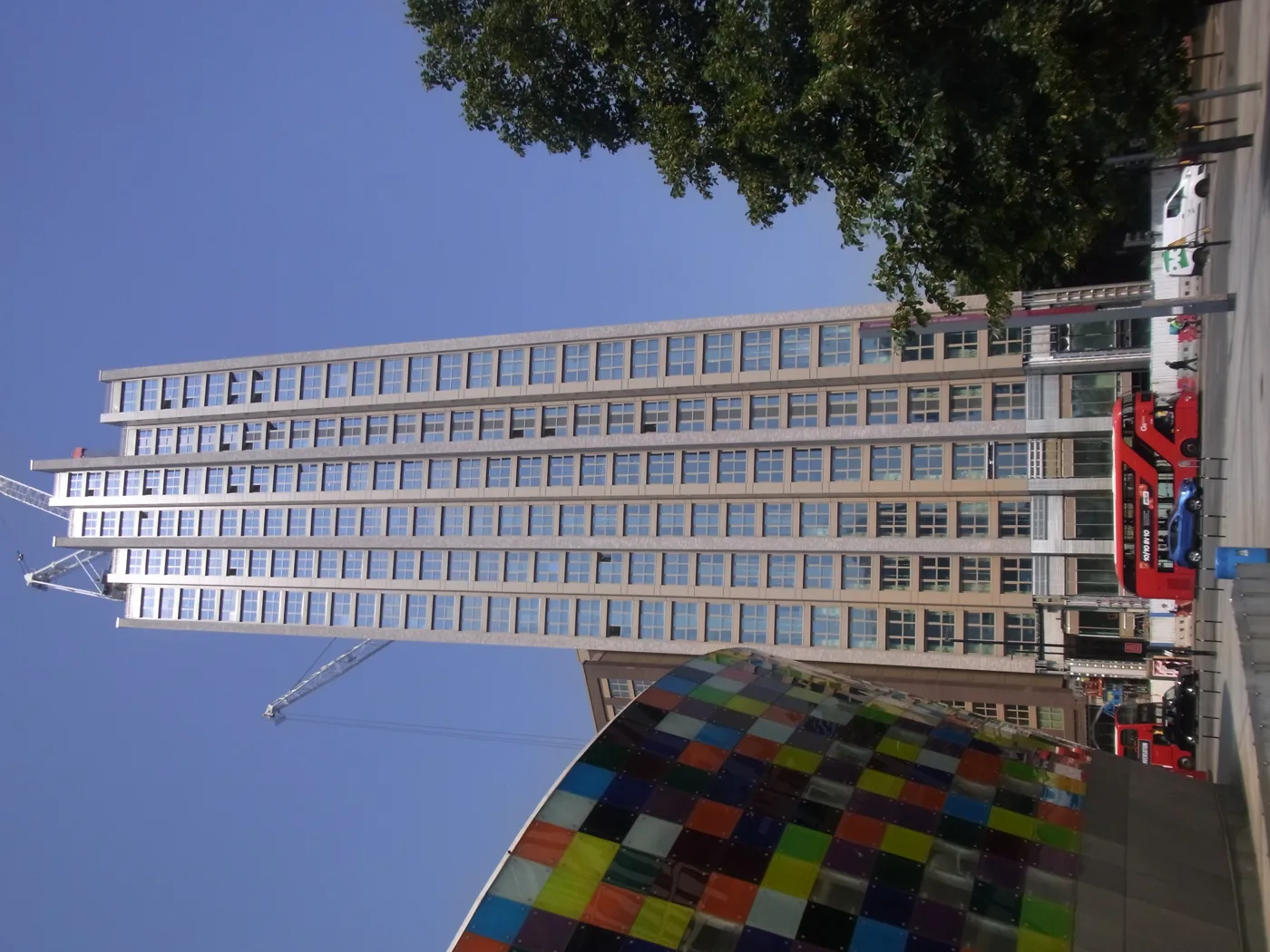

Lewisham has approved 2,865 student bedspaces against a draft London Plan target of 878. Cabinet votes on 4 November on consulting over discouraging new blocks.
Lewisham Council wants to discourage developers from building more student blocks in the borough. It says Lewisham already has far more student beds in the pipeline than London’s planners expect it to provide.
Mayor and Cabinet will be asked on Wednesday 4 November to approve a public consultation on a new “planning position statement”. The report to the meeting says further purpose-built student accommodation “will generally be discouraged” at the pre-application stage.
It is not a ban. A developer could still win permission with “a strong and robustly evidenced planning justification” and “exceptional wider public benefits”.
The numbers
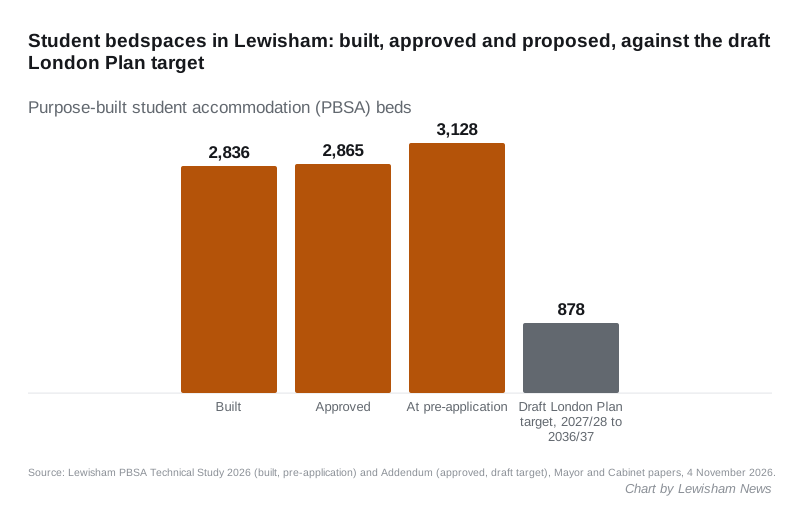
The council’s PBSA Technical Study 2026 counted the student beds already built and planned:
- 2,836 beds built
- 3,128 beds at the pre-application stage, in seven unnamed schemes
A later addendum to the study puts approved schemes at 2,865 bedspaces, expected to open between 2027/28 and 2036/37. The draft London Plan proposes a target of 878 student bedspaces for Lewisham over those ten years.
The study also works out a fair share for Lewisham under the current London Plan. Lewisham has 3.2% of London’s full-time students, so its share of the 3,500 beds London needs each year would be about 112 a year. Supply from 2019/20 to 2028/29 runs at 366 a year, more than three times that.
The approved schemes
The study lists five approved schemes:
| Scheme | Beds | Expected |
|---|---|---|
| Deptford Landing Plot 5 | 382 | 2026/27 |
| Apollo Business Centre | 484 | 2028/29 |
| Scott House | 502 | 2028/29 |
| Sun Wharf | 605 | 2028/29 |
| Lewisham Shopping Centre | 661 | 2031/32 |
The Lewisham Shopping Centre beds are part of Landsec’s redevelopment, which the council said on 20 October has been paused.
The biggest finished scheme is Lewisham Exchange, on the former Carpetright site, with 758 beds. Sherwood Court on Thurston Road has 611.
Why the council is worried
The report gives three reasons:
- Lost homes. Student blocks can take sites that would otherwise provide ordinary housing, “particularly genuinely affordable housing”. Every two and a half student beds counts as one home towards the borough’s housing target.
- Too many beds. The study says there is a need for student housing now, but future demand is “far more uncertain”. It cites fewer overseas students and more students living at home to save money.
- Concentration. The study treats a 20% to 25% student share of the population as the point of concern. No ward reaches it, but some smaller neighbourhoods will.
The neighbourhoods most affected
The study forecasts the student share of residents by 2029/30 in the small areas most affected, as the pipeline is built:
| Area | Students now (2023/24) | Forecast (2029/30) |
|---|---|---|
| Deptford Creekside | 6% | 34% |
| North of Deptford Park | 8% | 23% |
| North east of Millwall’s stadium | 11% | 18% |
| Folkestone Gardens area | 6% | 14% |
| West of Deptford Park | 7% | 14% |
| East of New Cross Road | 6% | 13% |
Lewisham town centre already has a student share of 21%, the study says, rising to a forecast 27% by 2039/40.
What developers would have to show
Under the statement, a developer would need to provide:
- a needs assessment, with student-to-bed ratios now and in future
- the student share at ward and neighbourhood level
- an assessment of harm to “mixed and balanced communities”, where relevant
- an assessment of the ordinary homes the site would otherwise provide, where relevant
The report says general benefits such as student spending, jobs or regeneration “will not normally be sufficient”. It gives one example of what might be: securing the future of a cultural or community facility of borough-wide importance.
It also points to a “good neighbours” scheme at Melfield Gardens, where Goldsmiths students support residents aged 55 and over. The council says it would back similar ideas.
What happens next
- 4 November: Mayor and Cabinet decides whether to consult.
- November to December: public consultation, for at least four weeks.
- June 2027: the final statement goes back to Mayor and Cabinet for adoption.
Until it is adopted, the council says the statement can carry only “limited weight” in planning decisions. Decisions still rest on Local Plan policy HO7.
What it means for you
- If you live in Deptford, New Cross or near Lewisham station, this is the policy that will shape whether more student blocks come to your street. The consultation is your chance to say so.
- Comment on planning grounds. The council will weigh need, lost housing and concentration, not the number of objections. Our Lewisham planning applications page explains how to comment on a live scheme.
- If you are a student or a Goldsmiths or Trinity Laban staff member, the consultation is open to you too. The study notes that most students living in Lewisham now study elsewhere in London.
We will publish the consultation dates and link when the council opens it.
Sources
- Mayor and Cabinet, 4 November 2026: agenda and all appendices, including the report, the draft Position Statement (Appendix A), the PBSA Technical Study 2026 (Appendix B) and the Technical Study Addendum (Appendix C)
- Report: Lewisham PBSA Planning Position Statement
Have your say