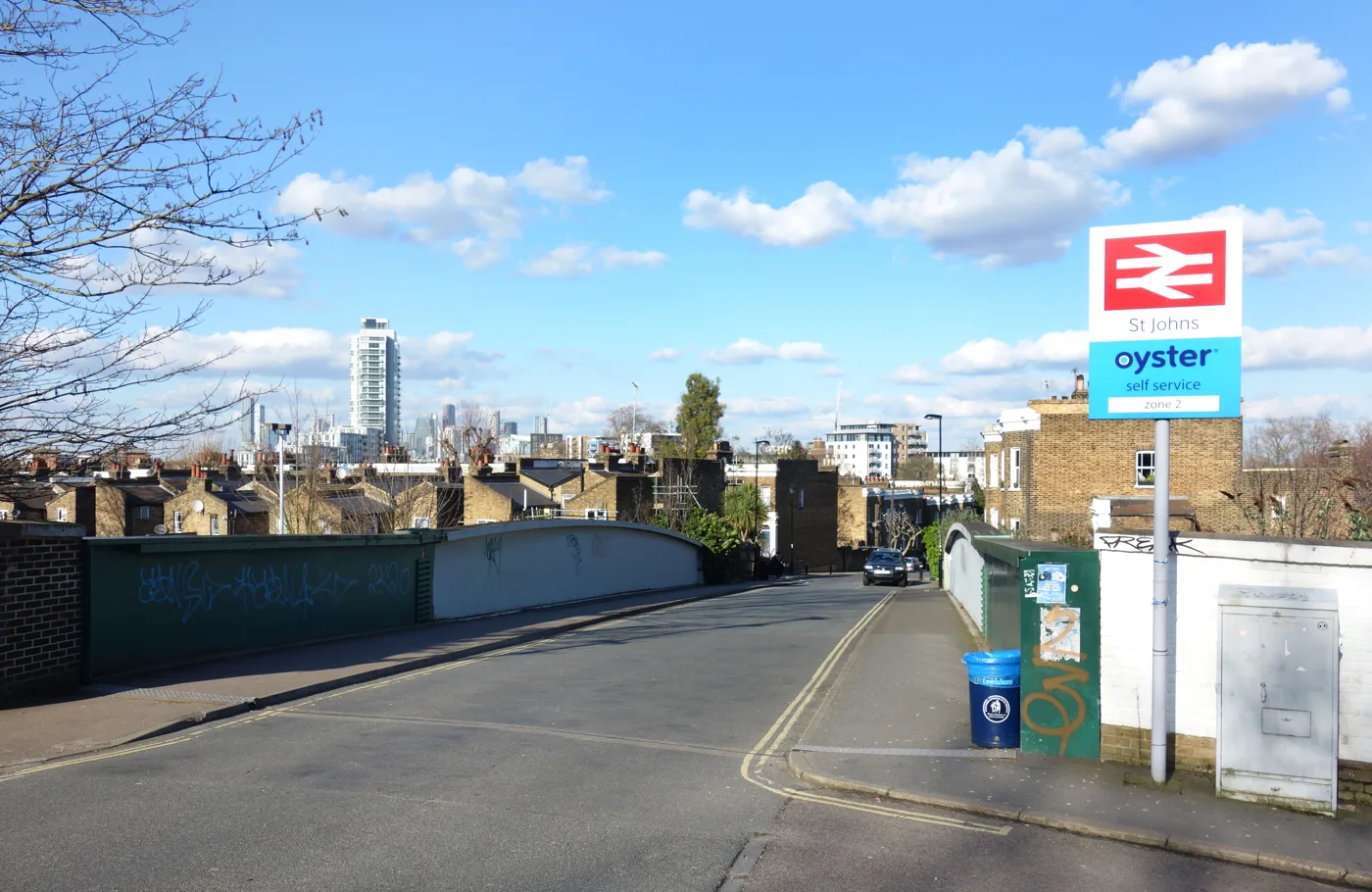

A maroon plaque to the 90 people killed in the 1957 St John's rail disaster was unveiled at the station on Saturday, in front of about 150 people.
A plaque remembering the 90 people who died in the 1957 St John’s rail disaster was unveiled at St John’s station on Saturday. The St John’s Society, which led the project, says about 150 people gathered at the station for the ceremony at midday on 19 September.
Vicky Foxcroft, the MP for Lewisham North, performed the unveiling. The maroon plaque sits on the long brick wall on the approach to the station entrance, where anyone passing can read it.
The ceremony included:
- speeches from Foxcroft, former councillor Steve Penfold, local historian Tony Redding and councillor Rotimi Skyers
- music from the Deptford Community Choir
- a trumpet solo by Josie Ashdown
According to the Society’s account of the day, Foxcroft spoke of the strength of the current St John’s community, and of honouring the residents of 1957 who helped with the rescue.
The disaster the plaque remembers
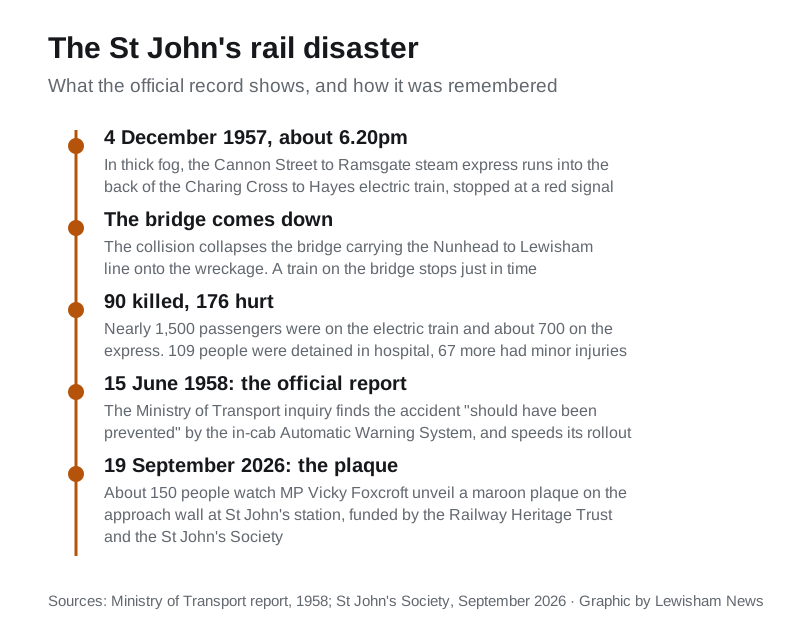
On the evening of Wednesday 4 December 1957, thick fog had thrown the rush hour into chaos and trains out of London were running late and overcrowded. At about 6.20pm, the 4.56pm steam express from Cannon Street to Ramsgate ran into the back of the 5.18pm electric train from Charing Cross to Hayes, which was stopped at a red signal just beyond St John’s station.
The collision brought down the bridge carrying the Nunhead to Lewisham line onto the wreckage below. A train approaching on that bridge was stopped just in time by its motorman.
The official Ministry of Transport report, published on 15 June 1958, records the scale of it:
- 90 people died: 88 passengers and the guard of the electric train were killed outright, and one passenger died later of his injuries
- 109 people were detained in hospital, many with very serious injuries, and 67 more suffered minor injuries or shock
- nearly 1,500 passengers were on the electric train, which had 958 seats, and about 700 were on the steam train
- the last of the injured was not brought out of the wreckage and taken to hospital until 10.30pm
It remains one of the worst railway accidents in British history. The St John’s Society describes it as Britain’s third worst.
The residents the ceremony honoured
The 1958 report did not only apportion blame. It found the express had passed two caution signals without slowing, and held its driver solely responsible. It also concluded that the accident “should have been prevented by Automatic Train Control of the Warning type”, the in-cab warning system whose national rollout the disaster helped to accelerate.
But the report also put on record what the people who lived beside the line did that night. The first emergency call came at 6.22pm from a house next to the railway. The inspector praised “the unselfish and generous way in which many lineside residents placed themselves, their houses and their belongings at the disposal of the rescue and first aid parties”.
Nearly 69 years on, that is the thread the ceremony picked up. The plaque honours the dead, and the neighbourhood that opened its doors to the injured.
Who paid for it
The plaque was funded by a donation from the Railway Heritage Trust together with the St John’s Society, the residents’ association for the area around the station. The Society’s announcement notes that Southeastern gave permission to mount it on the railway wall, and that the plaque carries the backing of the borough’s heritage scheme, though no council money was involved.
The maroon colour follows Lewisham’s maroon plaque scheme, the borough’s own answer to the blue plaque, which commemorates people and events from Edith Nesbit to the Battle of Lewisham.
What it means for you
- You do not need a ticket to see the plaque. It is on the public approach wall at St John’s station, off St John’s Vale.
- The station is served by Southeastern. Our trains and travel page has the current times and engineering work.
- Local historian Tony Redding, who spoke at the ceremony, is writing a book on the disaster, and the St John’s Society is still taking donations towards its memorial plaque fund.
Have your say